5914 - A 'Baby Deltic' Radio-Conrolled, Petrol Electric Locomotive in 5" Gauge - April 2024 (Update July 2026)
For Julie
... who always wanted a 'Deltic', but this'll fit in the car. Just!
July 2026 - It's Finished !!!
... And there's been some changes on the journey.
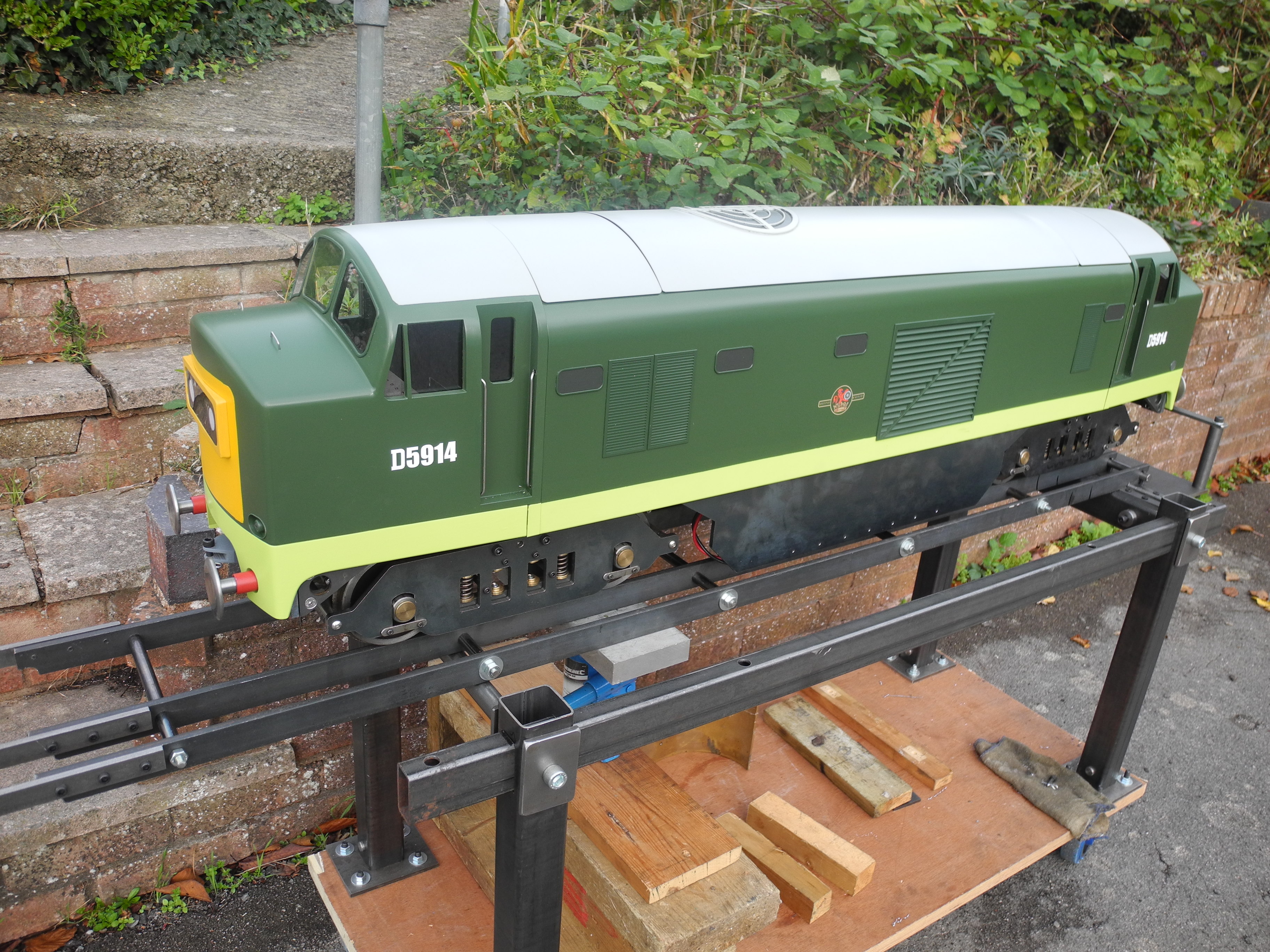
Baby Deltic 5914 in five inch gauge
First of all, infinite thanks go to one anonymous member of Bristol SMEE for his advice, work and assistance with the 3D printed cabs, body shell, painting, decals, and an attention to detail that makes this loco one for the gricers to think hard about before tutting at!
All of this gorgeousness in appearance, along with the latest electronic technology driving brushless motors (Jon's stuff) on the inside, this loco owes a lot to Bristol, and the intention is to use it for 'public running' duties at Ashton and elsewhere
Some changes along the way -
After a little nervousness about using the petrol generator as a power source, the loco is currently powered by a 24V 100AH LiFePO4 battery. The petrol gen can be substituted without too much of a fiddle.
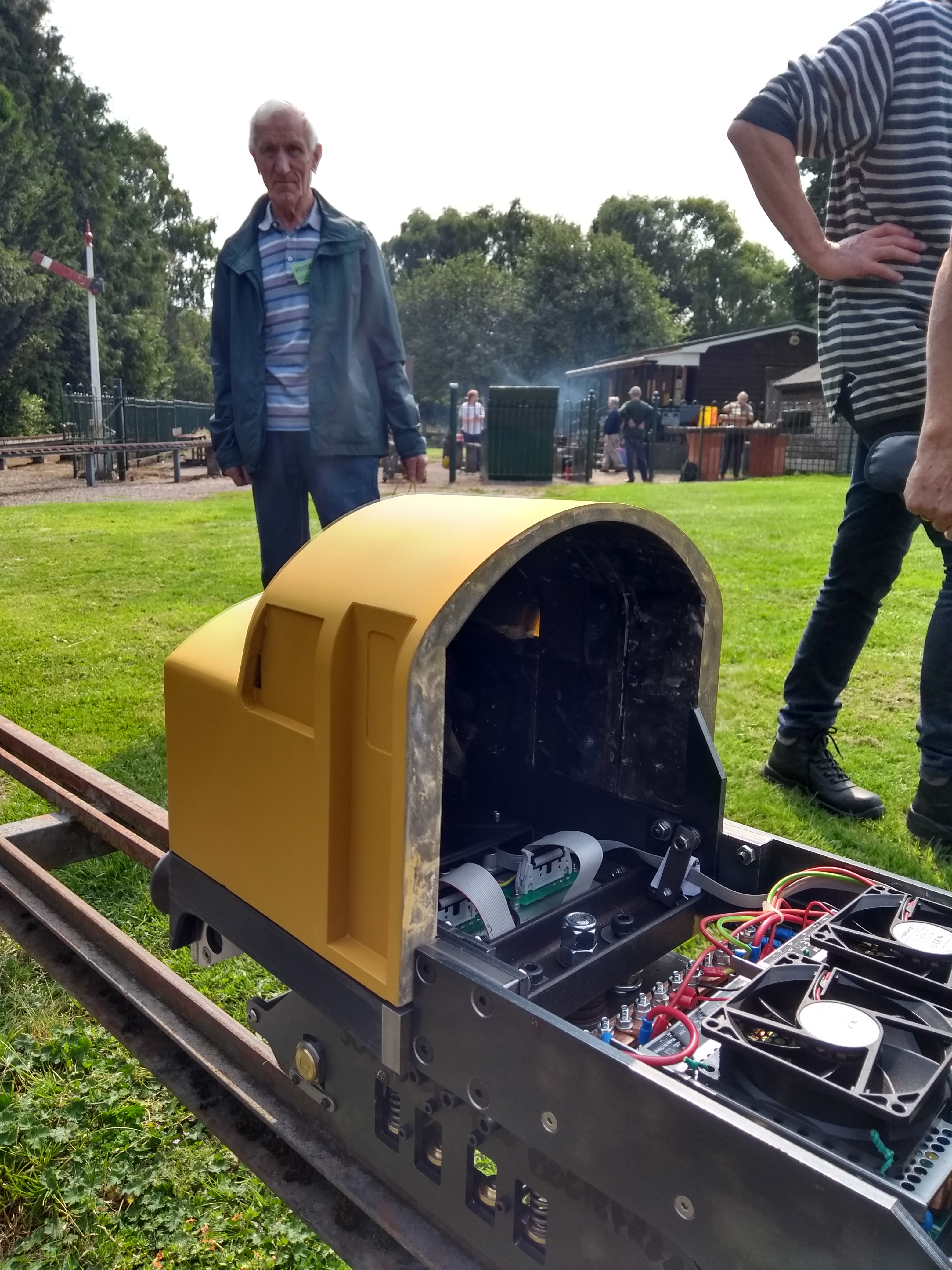
Driven by 4 brushless motors, each motor has its own custom designed electronic motor controller (EMC). This EMC achieves efficiency higher than in earlier of Jon's designs, using a variation on the 'six-step' algorithm incorporating 'quasi synchronous rectification', reducing heat dissipation in the controller to negligible levels. This means the EMC needs no bulky metal heatsink and can be miniaturised enough to be accommodated close to the motor it looks after. This helps keep wiring tidy and to the minimum.
The four EMCs communicate with a 'Central Locomotive Controller' using CAN Bus (in the same way as all the bits and pieces under your car bonnet do). This opens the way to use some fresh thinking about what we're trying to do here. You can find much more on contemporary design philosophy and the EMC controllers on this site under Electronics" - "EMC26"
The Central Locomotive Controller is nothing special, a simple printed circuit board with a decent microcontroller chip, a handful of other small components sufficient to implement the CAN and Bluetooth interfaces, and that's about it.
The Bluetooth hand controller (almost finished July 2026) is another simple microcontroller board driving an LCD touch-screen. A 'virtual' rotary control is used to drive the loco, while the display provides info on speed, distance travelled, power consumed, time, and more.
Until the hand controller is finished, driving is by means of radio control. Three chans are used as 1. Throttle/Brake, 2. Horn, and 3 Forward / park / Reverse.
See a brief video of the loco in action at Ashton Court here.
Continue down the page to see how we got here ...
April 2024
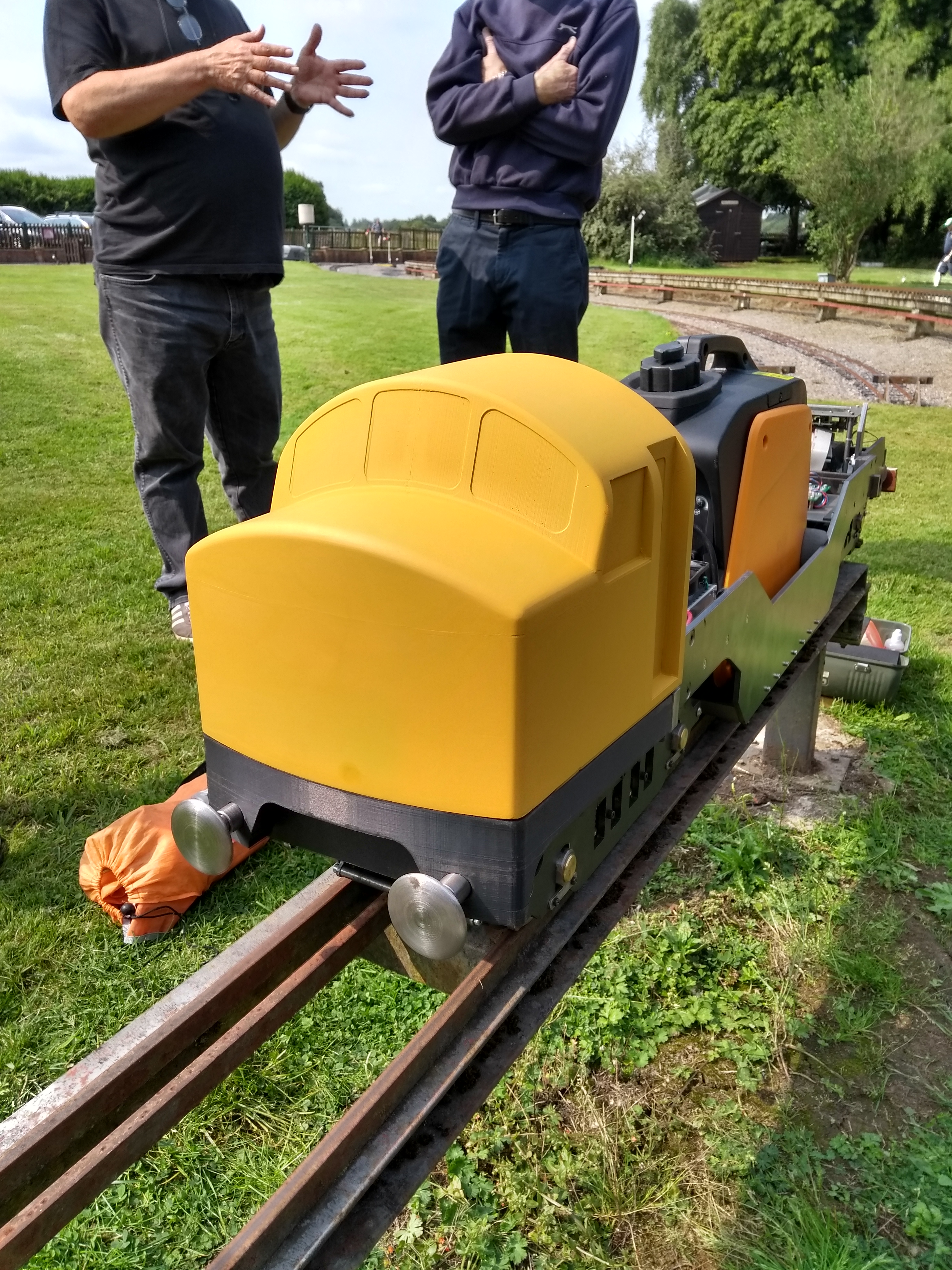
An all new locomotive design, this deviates from the 'Jons Workshop' norm in that it represents an attempt at modelling a real prototype, a British Rail class 23 'Baby Deltic' locomotive. It's the one I should have built ten years ago, but ...
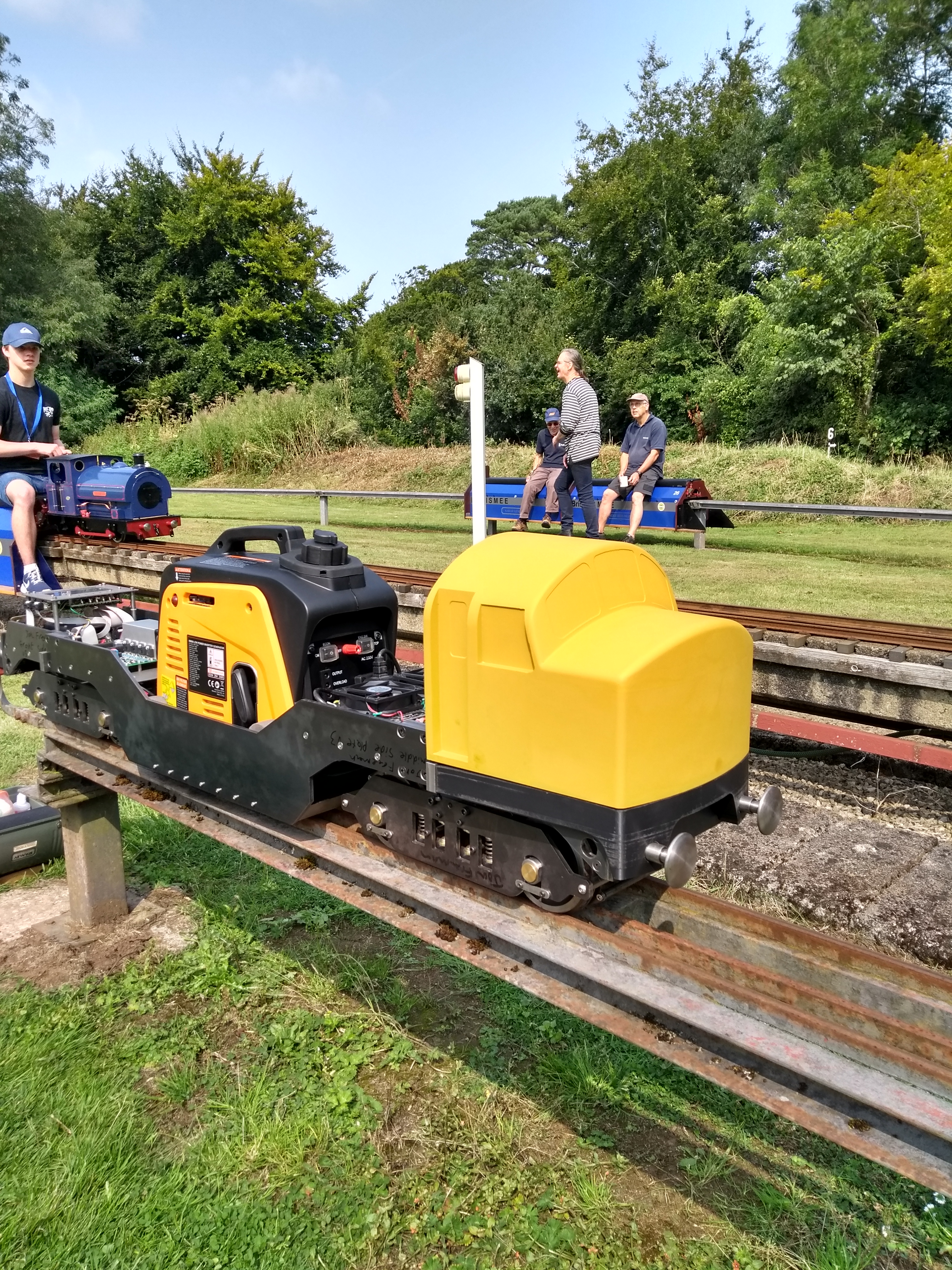
Fine scale, accurate modelling is all very well, but maybe not so for this build which is designed primarily to do some hard work, passenger hauling on club tracks. Minor liberties with scale had to be taken in order to fit the power unit, an off-the-shelf petrol inverter generator. Other details of the proposed bodywork are intended to look close to prototype, but may not be in the 'correct' positions. For example, one of the side vents is removeable to gain access to the engine pull-cord starter, this has to be where it is needed rather than where it was on the prototype.
One other benefit of stating at the outset, that this will be a tough and reliable hard-working, not fine-scale locomotive, is that the gricers can be sent packing in a sulk to go and sneer at someone elses work!
The bogies are to scale - wheel size and wheelbase are correct. One 220 Watt brushless motor is hung on each axle, gear driving the wheel. Gears are almost completely enclosed in a heavy laser-cut gearbox. This should prevent damage from foreign objects being thrown up into the works. Coil springs are used as primary suspension, as in the prototype. Secondary suspension uses coil rather than leaf springs for cost and ruggedness.
All electronics, bogie design and construction, and chassis and structural elements are the output of Jon's Workshop. For bodywork and cabs, our friends in a fine city not too far from here have been, and continue to be, of enormous help. Heartfelt thanks go out to all concerned - you know who you are!!
The main controller is a touch-screen computer as used for 'The Brute', with new connections powering and reading three channels from a radio control receiver. This controller communicates with the two STM3EMC motor controller drivers using a rather slow two-wire serial bus. Work is underway on a new brushless motor controller taking advantage of advances in technology over the six years since release of the STM3EMC. This will use 'CAN Bus' comms for better speed and reliability, while making it far more versatile.
The controller includes an odometer. To date the loco has completed 100km bricked up on the bench, and almost another 100km on the tracks at Ashton Court. All this without problem. Job's a good 'un.
Traction motors - 4 off 220W Brushless, Nanotec DB59M024035-A
Drive Electronics - STM3_EMC by Jon
Powered by petrol inverter - generator which adjusts engine revs according to need.
230V A.C. from the generator supplies two VOF-350C-27-CNF 27V, 13A switch-mode power supplies which deliver power to two ST3EMC Dual Brushless Motor Controllers. (Outputs not directly paralleled, negative common / chassis, positives combined using HTR40U60T Schottky diodes. This avoids over-voltage cutout during regenerative braking.)
Over-voltage protection provided by custom 'Power Clamp' which dissipates power developed during regenerative braking, details to follow.
Loco is driven by 'Radio Control', using a RadioLink T8FB Tx with R8EF Rx supplying three channels (drive, direction, horn) of info to a 'Touch Screen' controller as per the '18100' Turbine Loco, and 'The Brutalist'.
Useful data, reference manuals and stuff used in design of the all new electronics here